


 44 / 62

www.cmsb
.com.myCahya Mata
Sarawak
Berhad
40
In 2016, the Taskforce held eight meetings in which they
organised and subsequently implemented the following
initiatives:
• Enhancement to the Emergency Response Team at
the Wisma Mahmud building to ensure their ability
to respond to the emergencies. This included
conducting in-house training, fire drill, as well as
purchasing emergency response equipment.
• Internal training which included a fire drill, a first-aid
course, work-life balance activities and awareness of
OSH legal compliance.
• A Safety Month which also incorporated sustainability
initiatives such as tree-planting and a recycling
campaign.
• Site visits to work sites and plant/factories of
subsidiaries to enhance employees’ understanding
of OSH matters and to instil a sense of belonging
among them employees.
• Reshuffling of Safety employees within the group to
strengthen the implementation of Safety, Health and
Environment (SHE) activities.
OSH Structure and Roles & Responsibilities
The Group Safety Taskforce is headed by the Group
Managing Director. The Management Team of OSH in
the group is driven by 35 OSH Personnel that comprise
of 1 General Manager – Operations, Group Human
Resources, 1 Assistant Manager, 13 Executives and 20
Non-executives. These personnel are deployed in every
Division and Subsidiary company reporting functionally
to the respective CEO and administratively to the HQ
(General Manager and Assistant Manager).
An OSH Committee is established within every Division
and Subsidiary company to enforce OSH Implementation
and compliance with the related statutory requirements.
Approximately 95% of workforce represented by
these committees while the remaining 5% comprises
the subsidiary companies of trading, investments and
development businesses.
High Risk Occupational Activities
Workers involved in occupational activities with high
incidence or high risk of specific diseases.
Approximately 1,000 workers in the Cement and
Construction & Roads Maintenance Divisions are
involved in occupational activities with higher safety
and health risks, particularly mechanical, electrical, dust,
noise, ergonomic and psychosocial risks. The protection
extended to these workers is as follow:
• Engineering control (isolation, substitution, guarding
and advanced technology);
• Administrative control (safety procedures, work-
shifts, toolbox meeting and training); and
• Provision of proper Personal Protective Equipment
(PPE).
In relation to preventing serious diseases, we also render
assistance to assist our workforce, their family members
and the surrounding communities in a number of ways.
We choose to educate them on disease prevention and
treatment via the circulation of a newsletter, flyers and
notices throughout the Group, as well as through the
enforcement of strict hygiene and healthcare practices
throughout our operations. We also provide relevant and
specific training sessions that are conducted by in-house
trainers.
Other prevention measurements include the execution
of Hazard Risk Assessments at the workplace and the
medical surveillance for our workforce in accordance with
statutory requirements.
In the event of an incident, an Engaged Occupational
Doctor will provide counselling to the affected workforce.
The Group is committed to ensuring that the Recording
and Reporting of accidents strictly adheres to the
requirement of NADOOPOD Regulations 2004 in the
OSHA 1994. The five application forms are the JKKP6
– JKKP10 forms. However, the OSH Committee has
produced other forms for internal usage only. Accident
investigations will be conducted by the OSH Committee.
There were a total of 30 contractors with no record of
OSH Cases in 2016.
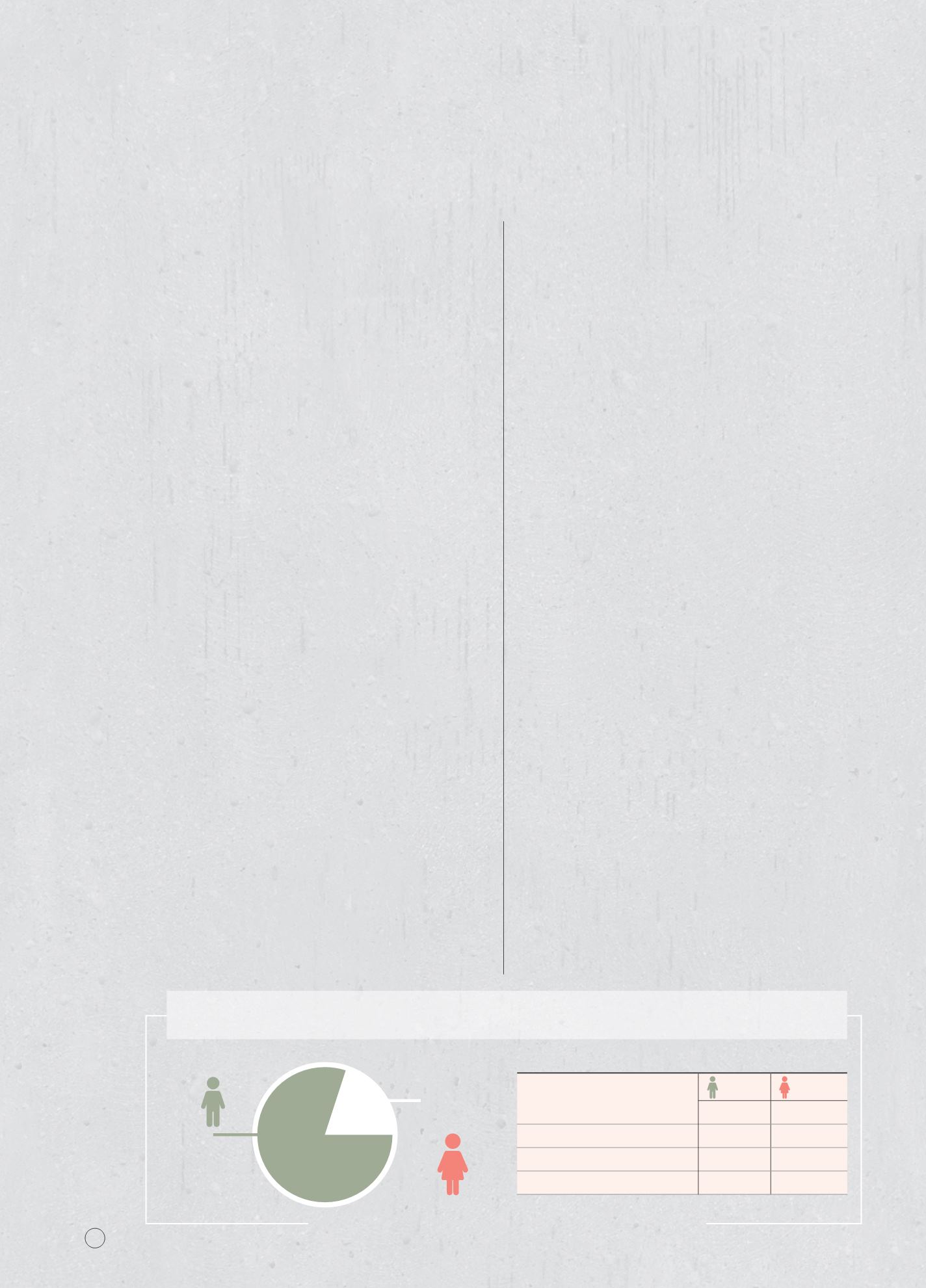
Social: Labour Practices and Decent Work
* For the whole group * Total manpower including office employees: 2,510
Report on type of injury, Injury Rate (IR), Occupational Diseases Rate (ODR), Lost Day Rate (LDR), Absentee
Rate (AR) and work-related fatalities for employees by region and gender FY 2016.
Male
2,000
Female
510
80%
20%
Male
Female
Injury Rate (IR)
5
2
Occupational Diseases Rate (ODR)
0
0
Lost Day Rate (LDR)
80
314
Absentee Rate (AR)
0
0