


 24 / 62

www.cmsb
.com.myCahya Mata
Sarawak
Berhad
20
is also expected to be created in the terms of domestic
direct investment and foreign direct investment. Upon
the Plant commencing operations, it will provide jobs
to 1,200 people while supporting other businesses and
industries such as ports and logistics.
MPAS is a Malaysian joint venture company between
our fully-owned subsidiary Samalaju Industries Sdn Bhd,
Malaysian Phosphate Venture Sdn Bhd (MPVS), and
Arif Enigma Sdn Bhd (AESB). Khazanah National Bhd’s
subsidiary, Malaysian Technology Development Corp
(MTDC), also holds a 40% equity stake in MPVS.
SUSTAINABLE PROCUREMENT
At CMS, our procurement procedures are transparent,
at arm’s length and conducted with a high level of
professional conduct. Transactions must be conducted
with standard commercial terms that are not more
favourable to related parties than those generally
available to the public.
We are committed to leading with integrity and
conducting business relationships with high ethical
standards. We insist that directors, owners, employees
and vendors (contractors, suppliers or consultants)
abide by the terms of our Code of Ethics and Business
Conduct (the Code) at all times which is accessible on our
Company’s website by all. Compliance with the Code is
also mandatory for vendors to maintain their registration.
Fair Competition
We expect our suppliers to compete honestly, fairly and
ethically for all business opportunities. We expect their
statements and representations to be true and accurate
in all respects. Suppliers and consultants are forbidden
from:
• Manipulating the tendering process with other
parties or entities;
• Engaging in any anti-competitive conduct including
tender-rigging and entering into any arrangement
with other parties that will compromise the genuine
competition of those tendering; and
• Submitting more than one tender through other
parties.
Our tendering processes have specific processes, checks
and balances built into them which are based on many
years of experience. Non-compliance to the tender
submitted would be investigated and tabled to the
Management for a decision. Such decisions may include
banning offenders from participating in future tenders for
a specified period.
Economic
Towards Transformational Growth
As CMS pursues transformational growth through
leveraging its strategic investments, we continue to
bolster our position of strength and widen our sphere of
influence.
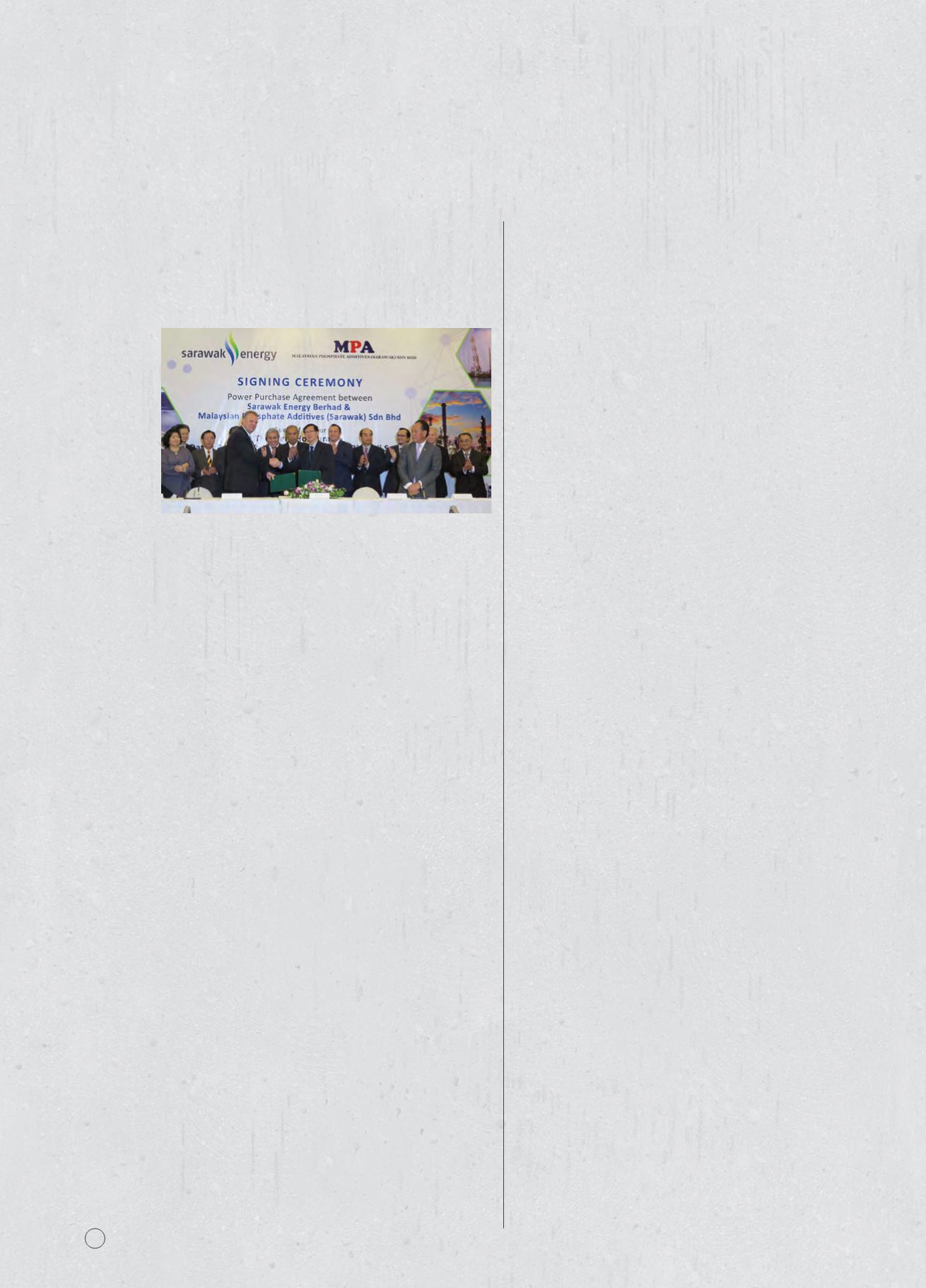
On 3 February 2016, Malaysian Phosphate Additives
(Sarawak) Sdn Bhd (MPAS) signed a Power Purchase
Agreement (PPA) with Sarawak Energy Berhad through
its wholly-owned subsidiary Syarikat SESCO Berhad,
to power what is set to become the largest integrated
phosphate additives plant in South East Asia. This was
followed by MPAS signing an Engineering Design,
Procurement and Construction (EPC) contract with a
consortium of contractors from China to build an RM2.20
billion Integrated Phosphate Complex on a 141.63 ha site
at the Samalaju Industrial Park (SIP) in Bintulu.
Scheduled for completion by end 2018, the Plant will
be built and financed jointly via loans and equity. The
Plant is set to have an annual production capacity of
approximately 500,000 MT of food, feed and fertiliser
phosphate additives; 100,000 MT of ammonia; and
900,000 MT of coke. This will be a significant increase
in production compared to the output of MPAS’ current
phosphate plant in Lumut Port, Malaysia which produces
about 30,000 MT of phosphate additives a year.
Using rock phosphate as its major raw material, the
Plant’s range of phosphate additive products will serve
as the feedstock in the production of various foods and
beverages. It will also replace the use of animal bones
in halal animal feed and in the production of fertilisers,
thereby ensuring the viability and sustainability of the
Malaysian agro food industry.
The total economic contributionof theproject is estimated
to be in the vicinity of RM12.90 billion, of which RM1.10
billion would be allocated to tax revenue with the balance
going to gross national income. A further RM4.70 billion